
Anthropic’s Claude Sonnet 4.5 represents a significant leap forward in autonomous agent capabilities. This latest upgrade transforms how AI systems handle complex, long-running tasks with unprecedented reliability and intelligence. With enhanced reasoning benchmarks, multi-step task execution, and advanced self-correction mechanisms, Claude Sonnet 4.5 sets a new standard for autonomous AI operations.
Understanding Claude Sonnet Architecture
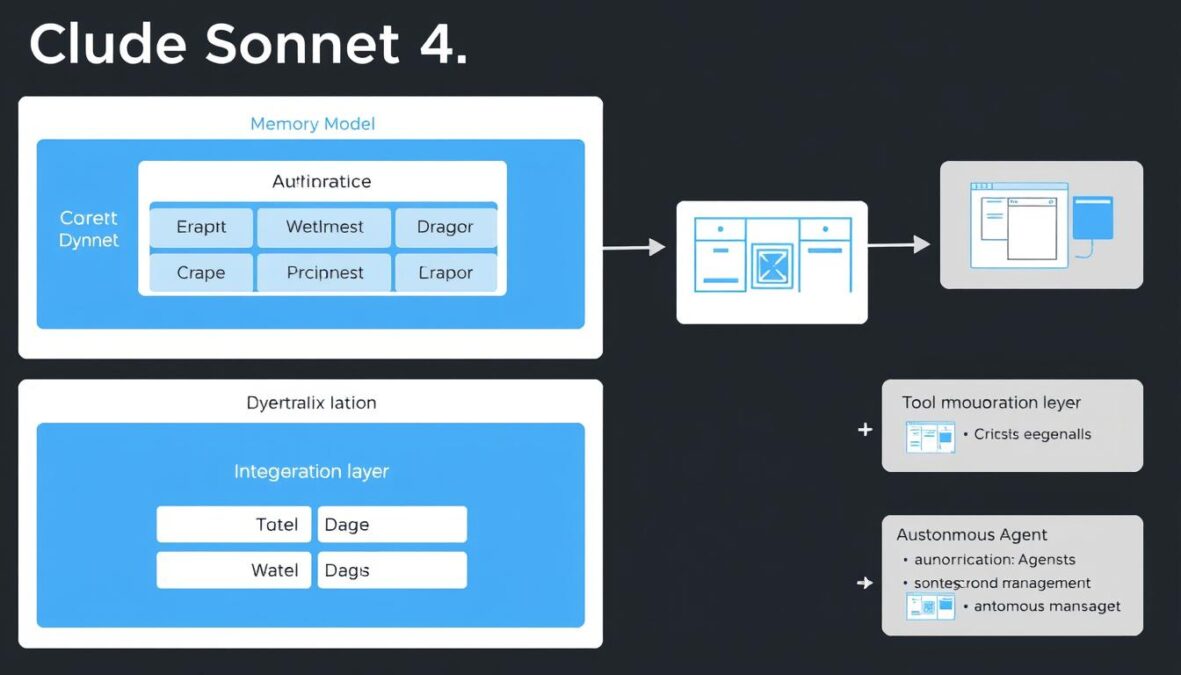
The Claude Sonnet architecture represents Anthropic’s most advanced framework for large language models designed specifically for autonomous operation. At its core, Sonnet utilizes a transformer-based architecture with significant enhancements to context processing, memory management, and tool integration capabilities.
Unlike previous Claude models, Sonnet implements a hierarchical attention mechanism that enables more effective parsing of complex instructions and maintaining goal orientation across extended operational periods. This architectural foundation allows Claude Sonnet 4.5 to maintain coherence during tasks spanning 30+ hours—a capability previously unattainable in autonomous AI systems.
Key architectural components include:
- Advanced context window management system for optimal token utilization
- External memory integration for persistent state tracking
- Hierarchical planning modules for complex task decomposition
- Tool use orchestration layer for coordinating multiple parallel operations
- Self-monitoring systems for error detection and correction
This architecture enables Claude Sonnet 4.5 to function as a true autonomous agent rather than simply a responsive assistant, capable of maintaining initiative and adapting to changing conditions throughout extended operational periods.
Key Improvements in Claude Sonnet 4.5
Enhanced Reasoning Benchmarks
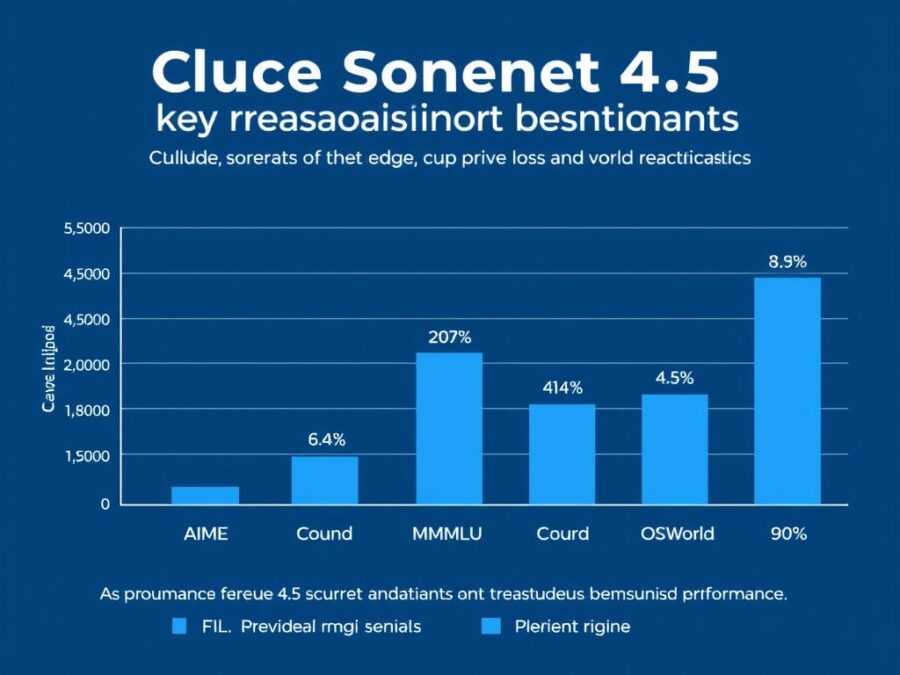
Claude Sonnet 4.5 demonstrates remarkable improvements in reasoning capabilities across multiple standardized benchmarks. On the American Invitational Mathematics Examination (AIME), Sonnet 4.5 achieves significantly higher scores than previous versions, demonstrating enhanced mathematical reasoning. The model shows substantial gains on the Massive Multitask Language Understanding (MMMLU) benchmark, particularly excelling in non-English languages with extended thinking capabilities.
Most notably, on OSWorld, a benchmark testing AI models on real-world computer tasks, Sonnet 4.5 leads at 61.4%—a dramatic improvement from Sonnet 4’s previous leading score of 42.2%. This represents a fundamental advancement in the model’s ability to reason about and interact with computer systems.
| Benchmark | Claude Sonnet 3.2 | Claude Sonnet 4.0 | Claude Sonnet 4.5 | Improvement (vs 4.0) |
| OSWorld | 28.7% | 42.2% | 61.4% | +19.2% |
| SWE-bench Verified | 52.6% | 69.8% | 77.2% | +7.4% |
| MMMLU (Multi-language) | 63.1% | 72.4% | 78.9% | +6.5% |
| AIME | 31.2% | 42.5% | 51.8% | +9.3% |
| Terminal-Bench | 58.3% | 71.7% | 84.2% | +12.5% |
Multi-Step Task Execution
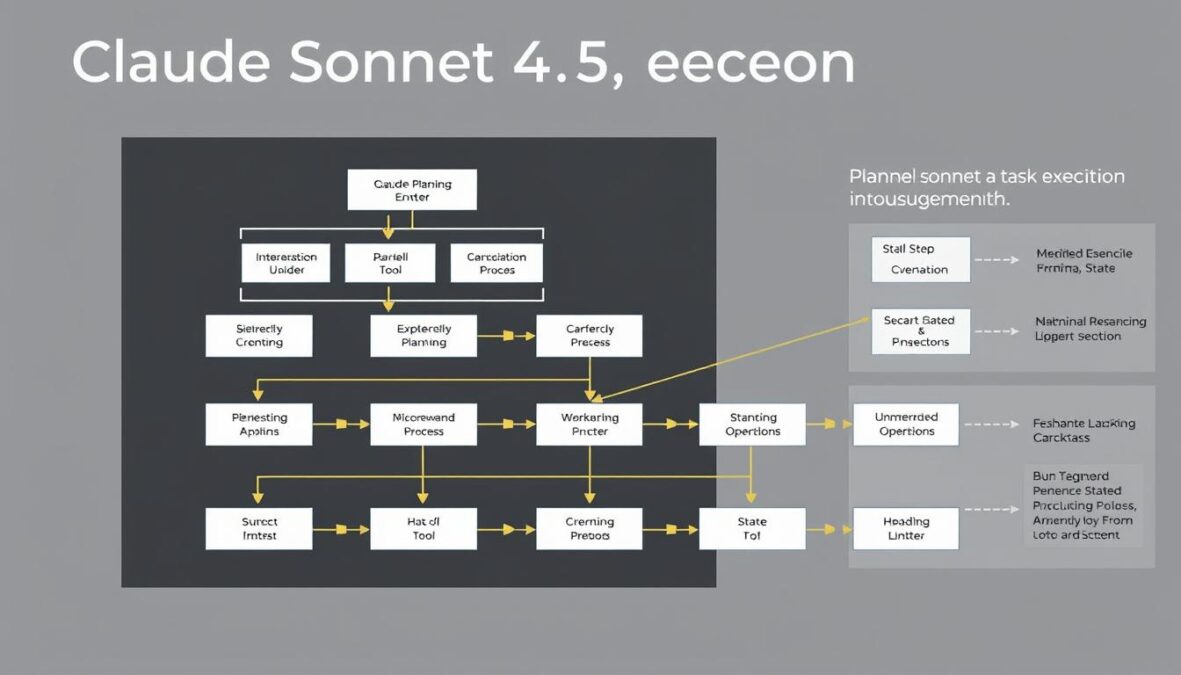
Claude Sonnet 4.5 excels at handling complex, multi-step tasks that require sustained focus and coordination. The model can now maintain clarity and focus for more than 30 hours on complex tasks—a capability that transforms how autonomous agents can be deployed in real-world scenarios.
Key advancements in multi-step task execution include:
- Hierarchical planning that breaks complex goals into manageable subtasks
- Parallel tool execution, allowing the model to fire off multiple speculative searches simultaneously or read several files at once
- Incremental progress tracking with fact-based updates
- State persistence across extended operational periods
- Automatic context prioritization to maintain focus on critical information
These capabilities enable Claude Sonnet 4.5 to tackle previously impossible tasks, such as autonomously developing complex software systems, conducting comprehensive research projects, or managing extended cybersecurity operations.
Self-Correction Mechanisms
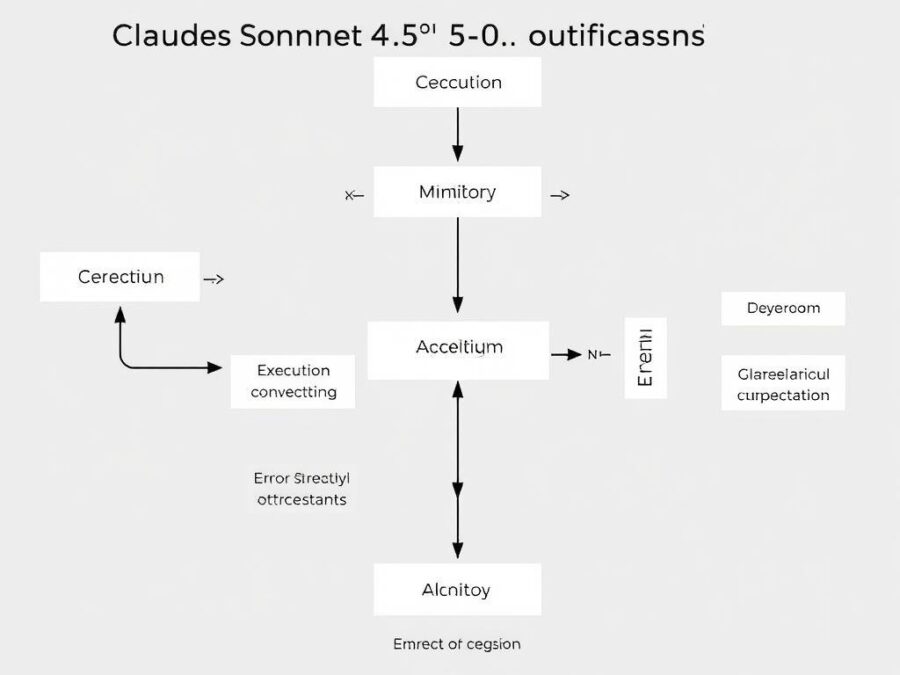
One of the most significant advancements in Claude Sonnet 4.5 is its enhanced self-correction capabilities. The model implements sophisticated mechanisms for detecting errors, evaluating alternative approaches, and implementing corrections without human intervention.
The self-correction system operates through:
- Continuous self-monitoring during task execution
- Automated testing of generated code and solutions
- Counterfactual reasoning to evaluate potential alternative approaches
- Graceful error handling with transparent reporting
- Learning from correction patterns to improve future performance
This self-correction capability dramatically improves the reliability of autonomous operations, reducing the need for human oversight while maintaining high-quality outputs even in complex scenarios.
Experience Advanced Autonomous Capabilities
Access Claude Sonnet 4.5 today and build AI agents capable of handling complex tasks with unprecedented reliability and intelligence.
Technical Breakdown of Autonomous Agent Features
Context Window Management
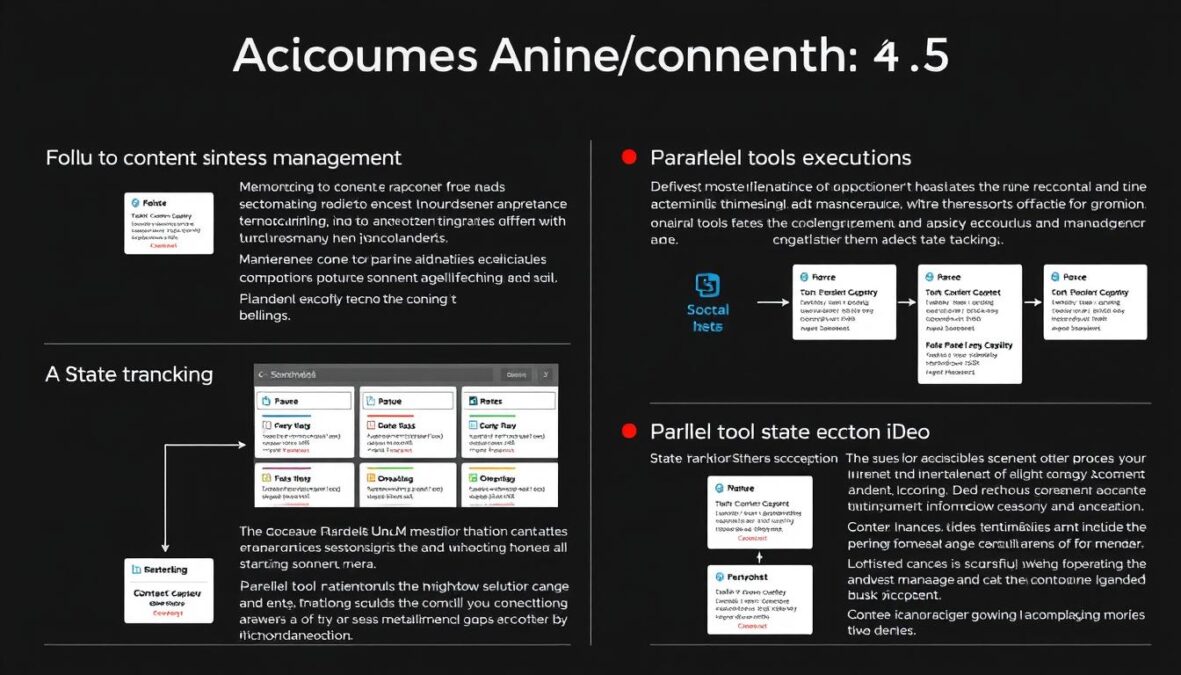
Claude Sonnet 4.5 introduces intelligent context window management that optimizes token usage throughout extended operations. The model now tracks token usage after each tool call and provides explicit stop reasons when generation hits context limits rather than requested limits.
This system enables more effective handling of long-running tasks by:
- Automatically prioritizing critical information within the context window
- Providing transparent reporting on context utilization
- Implementing graceful degradation when approaching context limits
- Maintaining coherence even when operating at context boundaries
Code Example 1: Implementing Smart Context Management
import anthropic

# Initialize Claude client
client = anthropic.Anthropic(api_key="your_api_key")

# Configure context management parameters
context_config = {
    "tracking_enabled": True,
    "priority_retention": ["goals", "constraints", "recent_actions"],
    "auto_summarize": True,
    "token_budget": 180000,  # Reserve 20K tokens for response
}

# Create conversation with context management
response = client.messages.create(
    model="claude-sonnet-4-5",
    max_tokens=20000,
    system="You are an autonomous agent tasked with long-running software development.",
    messages=[
        {"role": "user", "content": "Develop a complete REST API for inventory management."}
    ],
    context_management=context_config
)

# Check if response was limited by context window
if response.stop_reason == "context_window_limit":
    print(f"Response limited by context window. Utilized: {response.usage.input_tokens}")
    # Implement continuation strategy
Memory Tool Integration
Claude Sonnet 4.5 introduces a powerful memory tool (currently in beta) that enables the model to store and retrieve information outside the context window. This capability is crucial for autonomous agents that need to maintain state across extended operational periods.
The memory system provides:
- Persistent storage of key information across conversation sessions
- Structured organization of stored data for efficient retrieval
- Automatic prioritization of critical information
- Seamless integration with the model’s reasoning processes
Code Example 2: Implementing External Memory
import anthropic
from anthropic.tools import Tool

# Define memory tool schema
memory_tool = Tool(
    name="memory",
    description="Store and retrieve information from external memory",
    input_schema={
        "type": "object",
        "properties": {
            "action": {
                "type": "string",
                "enum": ["store", "retrieve", "update", "list", "delete"]
            },
            "key": {"type": "string"},
            "value": {"type": "string", "optional": True},
            "namespace": {"type": "string", "optional": True}
        },
        "required": ["action", "key"]
    },
    output_schema={"type": "string"}
)

# Initialize Claude client with memory tool
client = anthropic.Anthropic(api_key="your_api_key")

# Create conversation with memory tool
response = client.messages.create(
    model="claude-sonnet-4-5",
    max_tokens=1024,
    system="You are an autonomous agent with access to external memory.",
    messages=[
        {"role": "user", "content": "Remember my project requirements and provide updates as you work."}
    ],
    tools=[memory_tool]
)
Parallel Tool Execution
Claude Sonnet 4.5 demonstrates remarkable efficiency in tool usage through parallel execution capabilities. The model can now coordinate multiple simultaneous operations, such as running several bash commands at once or conducting parallel research queries.
This parallel processing capability:
- Dramatically improves efficiency for complex tasks
- Enables more comprehensive information gathering
- Reduces overall task completion time
- Maintains coherent integration of parallel results
Code Example 3: Implementing Parallel Tool Execution
import anthropic
from anthropic.tools import Tool
import asyncio

# Define tool schemas
bash_tool = Tool(
    name="bash",
    description="Execute bash commands",
    input_schema={"type": "string"},
    output_schema={"type": "string"}
)

search_tool = Tool(
    name="search",
    description="Search for information",
    input_schema={"type": "string"},
    output_schema={"type": "string"}
)

file_tool = Tool(
    name="file",
    description="Read or write files",
    input_schema={
        "type": "object",
        "properties": {
            "action": {"type": "string", "enum": ["read", "write", "append"]},
            "path": {"type": "string"},
            "content": {"type": "string", "optional": True}
        },
        "required": ["action", "path"]
    },
    output_schema={"type": "string"}
)

# Configure parallel execution
parallel_config = {
    "enabled": True,
    "max_parallel": 5,
    "timeout_seconds": 30
}

# Initialize Claude client
client = anthropic.Anthropic(api_key="your_api_key")

# Create conversation with parallel tool execution
async def run_parallel_agent():
    response = await client.messages.create(
        model="claude-sonnet-4-5",
        max_tokens=2048,
        system="You are an autonomous agent that uses parallel tool execution for efficiency.",
        messages=[
            {"role": "user", "content": "Research recent advances in quantum computing and summarize findings."}
        ],
        tools=[bash_tool, search_tool, file_tool],
        tool_execution=parallel_config
    )
    return response

# Run the async function
asyncio.run(run_parallel_agent())
Build Advanced Autonomous Workflows
Explore comprehensive documentation to implement these advanced autonomous agent features in your applications.
Real-World Applications of Claude Sonnet 4.5
Autonomous Software Development
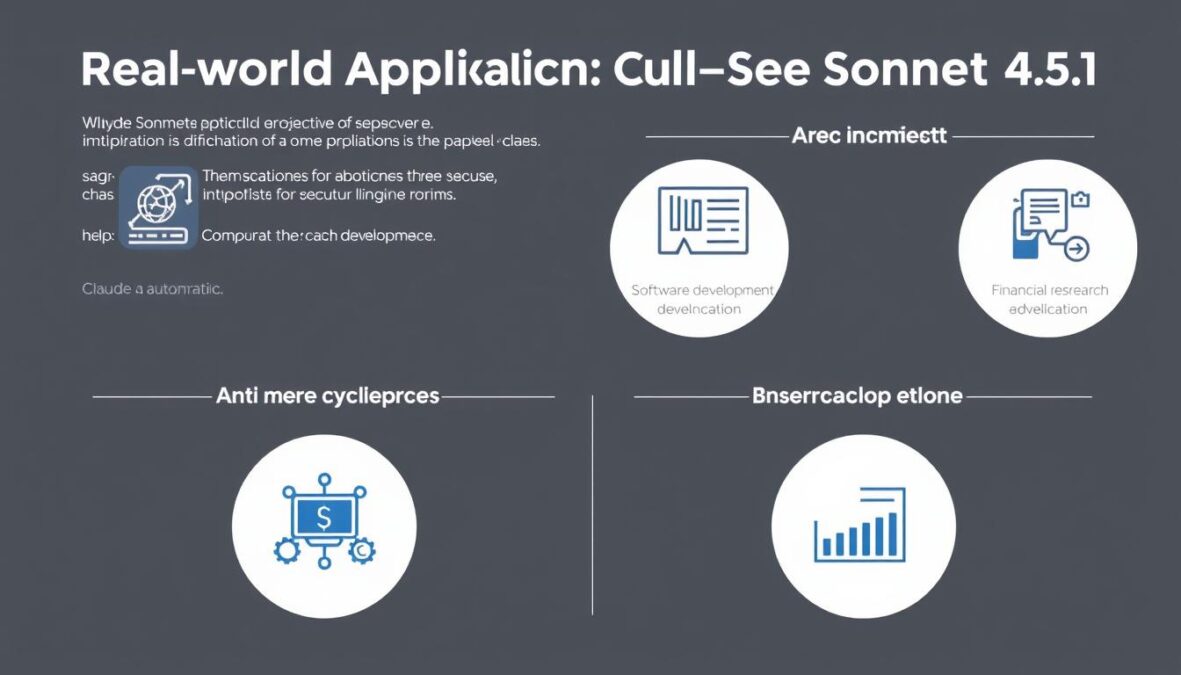
Claude Sonnet 4.5 transforms software development workflows by enabling autonomous coding over extended periods. The model can maintain focus for more than 30 hours on complex, multi-step development tasks while providing regular progress updates and maintaining code quality.
“Claude Sonnet 4.5 resets our expectations—it handles 30+ hours of autonomous coding, freeing our engineers to tackle months of complex architectural work in dramatically less time while maintaining coherence across massive codebases.”
Key capabilities for software development include:
- Comprehensive codebase understanding and pattern recognition
- Autonomous debugging and optimization
- Consistent implementation of architectural patterns
- Self-testing of generated code
- Documentation generation alongside implementation
Cybersecurity Operations

In cybersecurity, Claude Sonnet 4.5 enables a shift from reactive to proactive defense. The model can autonomously analyze vulnerabilities, generate patches, and monitor systems for extended periods without fatigue or oversight errors.
“Claude Sonnet 4.5 reduced average vulnerability intake time for our security agents by 44% while improving accuracy by 25%, helping us reduce risk for businesses with confidence.”
Cybersecurity applications include:
- Autonomous vulnerability assessment and patching
- Continuous security log analysis
- Threat intelligence gathering and correlation
- Security policy compliance verification
- Incident response automation
Financial Analysis

Claude Sonnet 4.5 demonstrates exceptional capabilities in financial analysis, from entry-level financial processing to advanced predictive analysis. The model can autonomously analyze complex financial data, identify patterns, and generate investment-grade insights.
“For complex financial analysis—risk, structured products, portfolio screening—Claude Sonnet 4.5 with thinking delivers investment-grade insights that require less human review. When depth matters more than speed, it’s a meaningful step forward for institutional finance.”
Financial applications include:
- Autonomous financial report generation and analysis
- Risk assessment for complex financial products
- Portfolio optimization and screening
- Regulatory compliance verification
- Market trend analysis and forecasting
Research Automation

In research contexts, Claude Sonnet 4.5 excels at handling tools, context, and delivering ready-to-use outputs. The model can autonomously conduct literature reviews, analyze research data, and generate comprehensive reports with minimal human oversight.
Research applications include:
- Comprehensive literature review and synthesis
- Data analysis and visualization
- Hypothesis generation and testing
- Research report generation
- Cross-disciplinary knowledge integration
Explore Industry-Specific Solutions
Discover how Claude Sonnet 4.5 can transform operations in your industry with autonomous agent capabilities.
Claude Sonnet 4.5 vs. Previous Versions
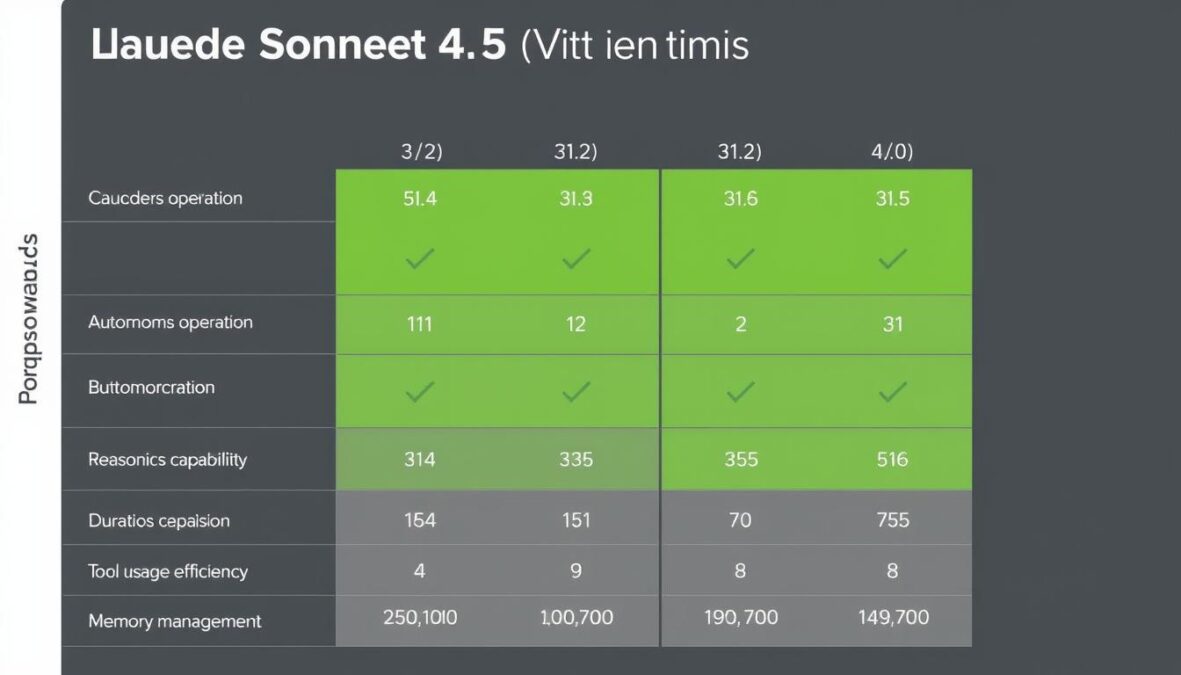
Claude Sonnet 4.5 represents a significant advancement over previous versions, particularly in autonomous agent capabilities. The following comparison highlights key differences in performance, features, and operational capabilities:
| Feature | Claude Sonnet 3.2 | Claude Sonnet 4.0 | Claude Sonnet 4.5 |
| Maximum autonomous operation time | 2-3 hours | 8-10 hours | 30+ hours |
| Context window management | Basic | Advanced | Intelligent with token tracking |
| External memory capabilities | None | Limited | Comprehensive (beta) |
| Parallel tool execution | Not supported | Limited | Full support |
| Self-correction capabilities | Basic | Moderate | Advanced with testing |
| Code editing accuracy | 25% error rate | 9% error rate | ~0% error rate |
| Multi-step reasoning | Limited | Good | Excellent |
| Cross-session memory | Not supported | Not supported | Supported |
| Progress reporting | Minimal | Basic | Comprehensive |
| Safety alignment | Strong | Very strong | Most aligned frontier model |
The improvements in Claude Sonnet 4.5 represent a generational leap in autonomous agent capabilities, particularly in areas critical for extended operations such as context management, memory integration, and self-correction mechanisms.
Expert Analysis: Implications for AI Development

Claude Sonnet 4.5’s advancements in autonomous agent capabilities have significant implications for the broader field of AI development. Industry experts highlight several key areas of impact:
Redefining AI Autonomy Standards
The ability to maintain coherent operation for 30+ hours fundamentally changes expectations for autonomous AI systems. This extended operational capability enables applications previously considered impractical, from continuous security monitoring to complex creative and technical projects requiring sustained focus.
“Claude Sonnet 4.5 establishes a new baseline for what constitutes a truly autonomous agent. The combination of extended operational time, self-correction, and memory management creates systems that can function with minimal human oversight while maintaining reliability.”
Scalability Challenges and Solutions
While Claude Sonnet 4.5 represents a significant advancement, experts note important scalability considerations. The model’s enhanced capabilities come with increased computational requirements, particularly for extended operations. Organizations implementing these autonomous agents must carefully consider infrastructure requirements and optimization strategies.
Key scalability considerations include:
- Computational resource allocation for long-running tasks
- Efficient token usage strategies to maximize context window utilization
- Implementation of checkpointing for fault tolerance
- Strategic use of external memory systems to reduce context window pressure
- Monitoring and observability solutions for autonomous operations
Future Development Trajectory
Claude Sonnet 4.5 points toward a future development trajectory focused on increasingly autonomous and reliable AI systems. Experts anticipate several key trends emerging from this foundation:
- Further integration of specialized knowledge and domain expertise
- Enhanced coordination between multiple autonomous agents
- More sophisticated self-improvement mechanisms
- Deeper integration with physical systems and robotics
- Continued advances in alignment and safety for autonomous systems
“The most significant implication of Claude Sonnet 4.5 is how it shifts the human-AI relationship from constant supervision to strategic oversight. This fundamentally changes how organizations can deploy AI for complex, time-intensive tasks.”
Stay Informed on AI Advancements
Access detailed technical documentation and safety information for Claude Sonnet 4.5.
Frequently Asked Questions
What security protocols are implemented in Claude Sonnet 4.5?
Claude Sonnet 4.5 is released under Anthropic’s AI Safety Level 3 (ASL-3) protections, which include comprehensive safeguards for models with advanced capabilities. Security features include:
- Advanced classifiers to detect potentially dangerous inputs and outputs
- Specific protections against chemical, biological, radiological, and nuclear (CBRN) content
- Improved defenses against prompt injection attacks
- Reduced sycophancy, deception, and power-seeking behaviors
- Comprehensive monitoring and logging for autonomous operations
For detailed security information, refer to the Claude Sonnet 4.5 System Card.
What API integration changes are required to upgrade to Claude Sonnet 4.5?
Claude Sonnet 4.5 is designed as a drop-in replacement for previous versions, requiring minimal changes to existing integrations. Key API updates include:
- New optional parameters for context management and memory tools
- Enhanced stop reason reporting for context window limits
- Support for parallel tool execution configuration
- Cross-conversation memory capabilities
Existing applications using Claude Sonnet 4.0 can immediately benefit from improved performance without code changes, while new features require minimal additional configuration.
What are the recommended cost optimization strategies for Claude Sonnet 4.5?
While Claude Sonnet 4.5 maintains the same pricing as Claude Sonnet 4 (/ per million tokens), its enhanced capabilities enable several cost optimization strategies:
- Utilize the new context editing feature to remove unnecessary information
- Implement the memory tool to store information outside the context window
- Configure automatic tool result clearing for long conversations
- Use parallel tool execution to reduce overall operation time
- Implement checkpointing for long-running tasks to enable efficient restarts
These strategies can significantly reduce token consumption while maintaining or improving performance for complex autonomous operations.
How does Claude Sonnet 4.5 handle long-running autonomous tasks?
Claude Sonnet 4.5 implements several mechanisms for maintaining performance during long-running tasks:
- Intelligent context window management to prioritize critical information
- External state tracking in memory files to preserve goal orientation
- Regular progress reporting with fact-based updates
- Automatic recovery mechanisms for handling interruptions
- Efficient token usage to maximize operational duration
These capabilities enable the model to maintain focus and effectiveness for 30+ hours on complex tasks—a significant improvement over previous versions.
What infrastructure is recommended for deploying Claude Sonnet 4.5 autonomous agents?
For optimal performance of Claude Sonnet 4.5 autonomous agents, consider the following infrastructure recommendations:
- Implement robust API request handling with retry logic
- Utilize the Claude Agent SDK for complex agent implementations
- Deploy monitoring and observability solutions for autonomous operations
- Implement checkpointing mechanisms for fault tolerance
- Consider cloud-based deployment for scalability and reliability
These infrastructure considerations help maximize the reliability and effectiveness of autonomous agents built with Claude Sonnet 4.5.
Ready to Build Autonomous Agents?
Get started with Claude Sonnet 4.5 and transform your AI applications with advanced autonomous capabilities.
Conclusion: The Future of Autonomous AI

Claude Sonnet 4.5 represents a significant milestone in the evolution of autonomous AI systems. With its unprecedented capabilities for extended operation, enhanced reasoning, and sophisticated self-correction, it establishes new standards for what autonomous agents can accomplish.
The advancements in Claude Sonnet 4.5 enable a fundamental shift in how organizations can deploy AI—moving from systems that require constant supervision to truly autonomous agents capable of handling complex, multi-step tasks over extended periods. This transformation opens new possibilities across industries, from software development and cybersecurity to financial analysis and research.
While challenges remain in scaling and optimizing these systems, Claude Sonnet 4.5 provides a solid foundation for the next generation of autonomous AI applications. As organizations implement these capabilities, they will discover new ways to enhance productivity, solve complex problems, and create value through intelligent automation.
The future of autonomous AI is here, and Claude Sonnet 4.5 is leading the way.
There are no reviews yet. Be the first one to write one.