
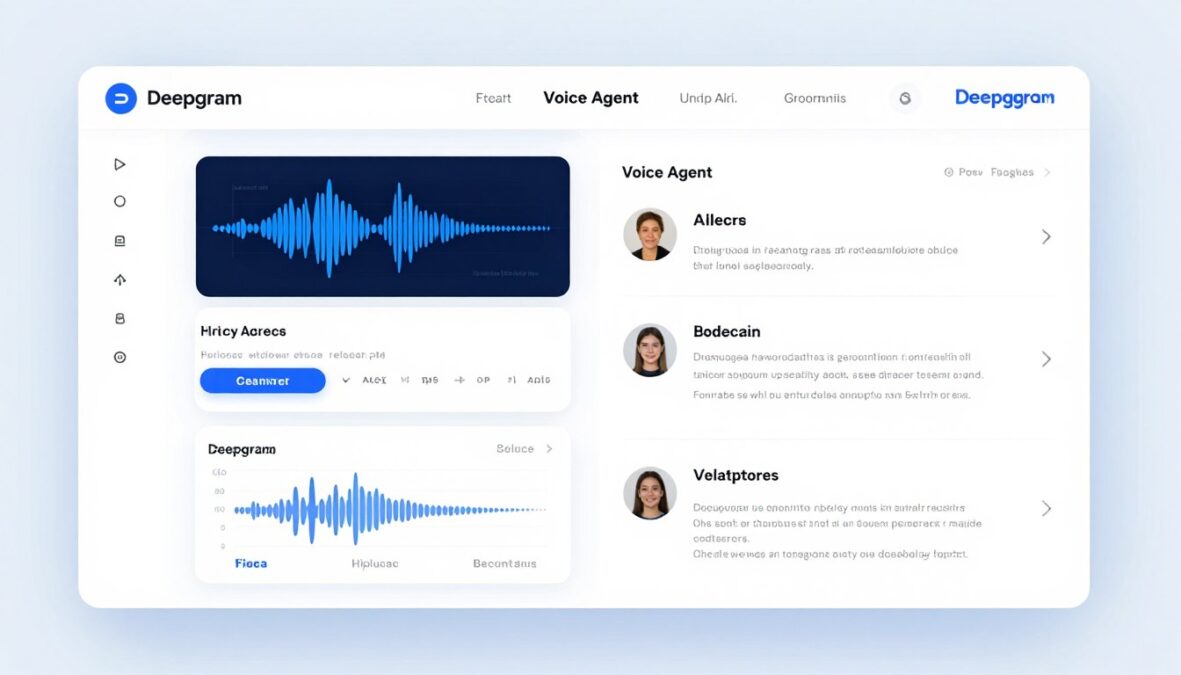
Voice AI is transforming how businesses interact with customers, and Deepgram’s Voice Agent API stands at the forefront of this revolution. This unified API combines speech recognition, language processing, and voice synthesis into a seamless solution that enables natural, responsive conversations between humans and machines. In this comprehensive guide, we’ll explore what makes the Deepgram Voice Agent API unique, its powerful capabilities, and how businesses across industries are leveraging it to create exceptional voice experiences.
What is the Deepgram Voice Agent API?
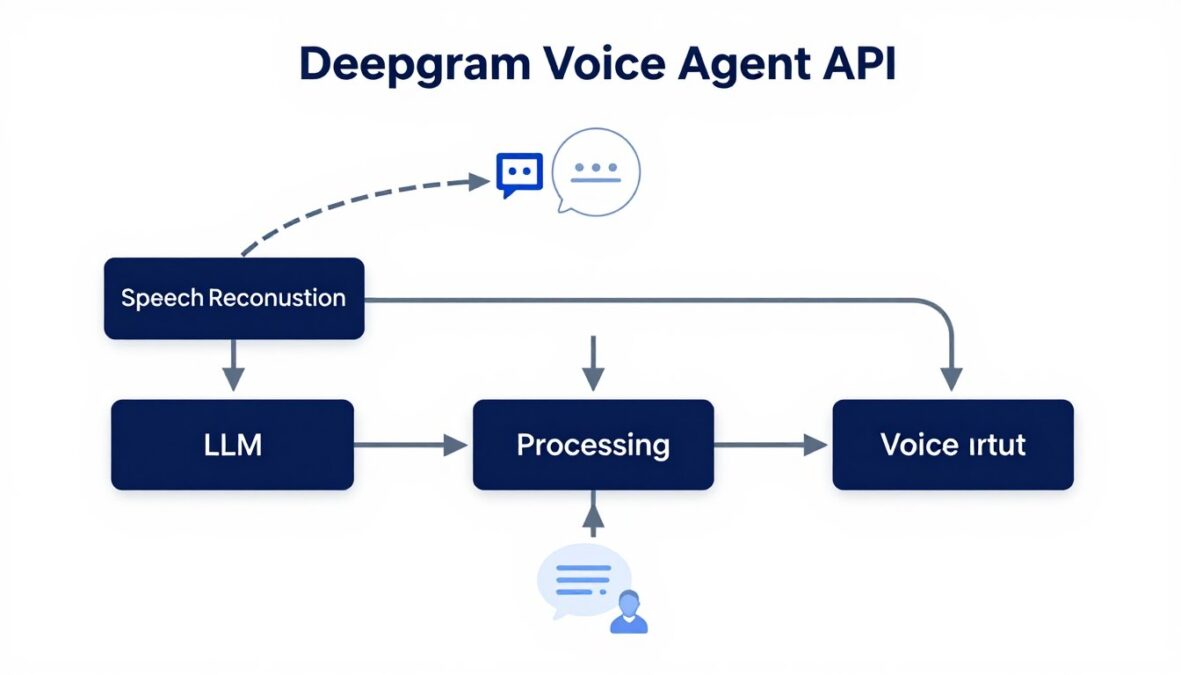
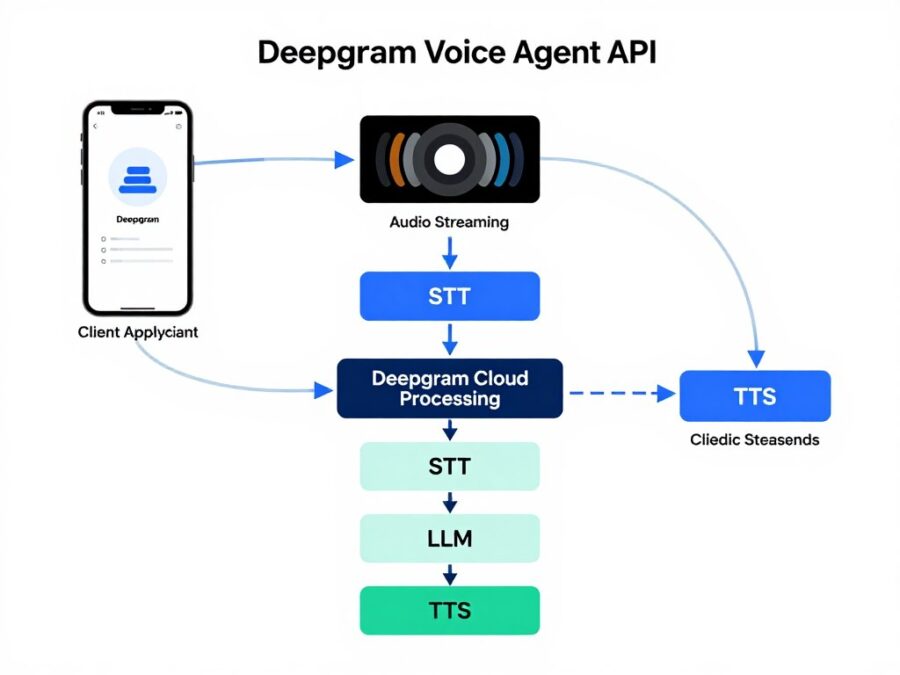
The Deepgram Voice Agent API is a unified voice-to-voice interface that enables developers to build intelligent, conversational AI agents without the complexity of integrating multiple services. Unlike traditional approaches that require stitching together separate speech-to-text, language processing, and text-to-speech components, Deepgram provides a single API that handles the entire voice interaction pipeline.
Experience Deepgram Voice Agent API Today
Try the world’s most powerful voice agent platform with $200 in free credits.
Key Technical Features
Unified Voice Agent API
One API that combines speech-to-text, LLM orchestration, and text-to-speech in real time, eliminating the need to stitch together multiple services.
Real-Time Conversational Control
Built-in barge-in detection, turn-taking prediction, and function calling ensure smooth conversations without awkward pauses or interruptions.
Full Model Ownership
Deepgram controls the full voice stack across STT, TTS, and runtime orchestration for optimized latency and tightly synchronized speech-to-speech flow.
Flexible Deployment Options
Deploy fully managed, dedicated single-tenant, in VPC, or self-hosted to meet enterprise requirements for security and compliance.
BYO LLM & TTS
Easily integrate your own LLM or TTS provider while retaining Deepgram’s orchestration, streaming pipeline, and real-time responsiveness.
Cost-Effective Scaling
Flat-rate pricing at $4.50/hr with Deepgram’s full stack, plus built-in rate reductions for BYOM, optimizing costs for large-scale deployments.
Strengths and Considerations
Strengths
- Ultra-low latency for natural conversation flow
- Simplified development with unified API
- Superior speech recognition accuracy
- Natural turn-taking and interruption handling
- Enterprise-grade security and deployment options
- Predictable, flat-rate pricing model
Considerations
- Higher learning curve for advanced customizations
- Requires understanding of conversational design
- Best performance requires quality audio input
- May need fine-tuning for specialized domains
Integration Options
Deepgram provides multiple ways to integrate the Voice Agent API into your applications:
- REST API: Standard HTTP requests for synchronous interactions
- WebSocket API: Real-time streaming for live voice interactions
- SDKs: Official libraries for JavaScript, Python, Node.js, and more
- Pre-built Integrations: Connectors for platforms like Twilio, Kore.ai, and OneReach.ai
Primary Use Cases for Deepgram Voice Agent API
The Deepgram Voice Agent API enables a wide range of applications across industries. Here are some of the most compelling use cases where organizations are leveraging this technology to transform their operations and customer experiences.
Customer Service & Support
Voice agents are revolutionizing customer service by providing immediate, 24/7 support without the limitations of traditional IVR systems or the cost of human agents.
AI-Powered Call Centers
Deepgram’s Voice Agent API enables intelligent voice agents that can handle routine inquiries, process transactions, and escalate complex issues to human agents when necessary. The natural conversational flow and real-time responsiveness create a seamless experience that feels human-like rather than robotic.
Interactive Voice Response (IVR)
Unlike traditional IVR systems that follow rigid decision trees, Deepgram-powered voice agents understand natural language and context. They can handle complex queries, adapt to conversation flow, and even detect customer sentiment to provide more empathetic responses.
“We believe that integrating AI voice agents from Deepgram will be one of the most impactful initiatives for our business operations over the next five years, driving unparalleled efficiency and elevating the quality of our service.”
Voice-Enabled Productivity Tools
The Deepgram Voice Agent API is powering a new generation of productivity tools that leverage voice for more natural and efficient workflows.

Meeting Assistants
Voice agents can join virtual meetings to transcribe conversations, identify action items, and generate summaries in real-time. The Deepgram API’s ability to distinguish between speakers, understand context, and process natural language makes it ideal for capturing the nuances of complex discussions.
Voice-First Workflows
From dictation systems for healthcare professionals to hands-free operation for field technicians, voice agents are enabling more efficient workflows in environments where keyboard input is impractical. Deepgram’s low-latency processing and high accuracy make these applications feel responsive and reliable.
Accessibility Solutions
Voice agent technology is breaking down barriers for users with disabilities, creating more inclusive digital experiences.
Real-Time Captioning
Deepgram’s Voice Agent API powers applications that provide real-time captioning for deaf or hard-of-hearing individuals. The high accuracy and low latency ensure that captions keep pace with spoken content, making digital media and live events more accessible.
Voice-Controlled Interfaces
For users with mobility impairments, voice agents offer a hands-free way to interact with digital systems. The natural language understanding capabilities of Deepgram’s API enable intuitive control of applications without the need for keyboard or mouse input.
See Deepgram Voice Agent API in Action
Experience the power of real-time, natural voice interactions with our interactive demo.
Gaming & Interactive Entertainment
Voice agents are creating more immersive and responsive gaming experiences by enabling natural conversations with non-player characters (NPCs).
Game developers are using Deepgram’s Voice Agent API to create NPCs that can engage in dynamic, contextual conversations with players. Unlike scripted dialogue trees, these voice-powered characters can respond to a wide range of player inputs, remember previous interactions, and adapt their responses based on the game state and player history.
IoT and Smart Devices
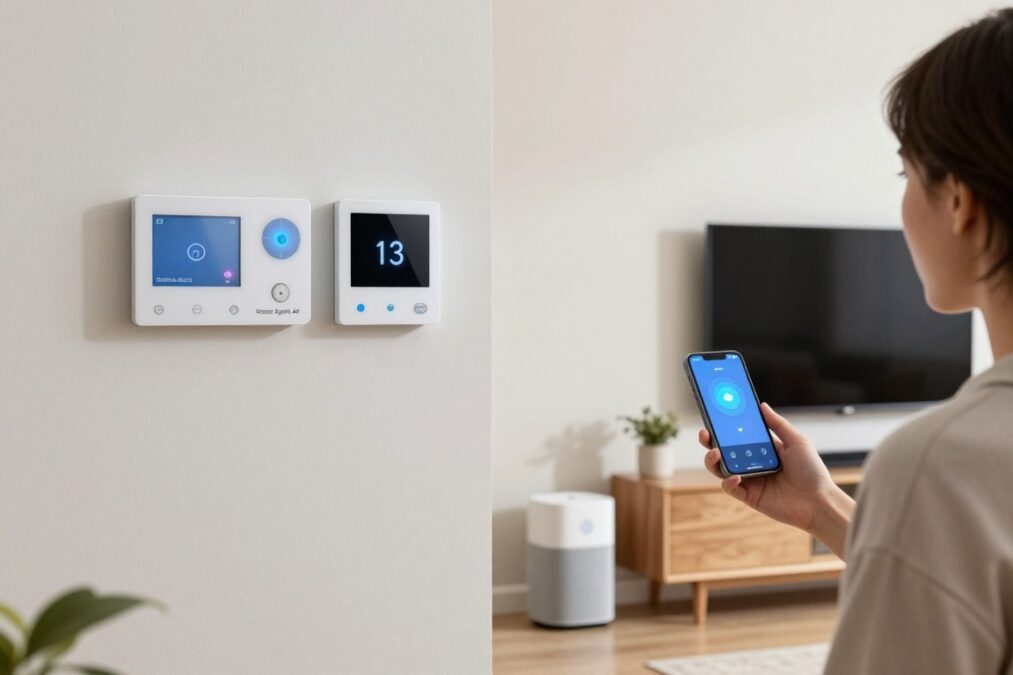
Voice is becoming the primary interface for smart homes, vehicles, and other IoT devices, and Deepgram’s Voice Agent API is enabling more natural and capable voice control.
Smart Home Control
Voice agents powered by Deepgram enable more natural control of smart home devices. Users can issue complex commands in conversational language, and the system can ask for clarification when needed, creating a more intuitive experience than traditional voice commands.
In-Vehicle Assistants
Automotive manufacturers are integrating voice agents to create safer, more convenient in-vehicle experiences. Deepgram’s noise-robust speech recognition and low-latency processing are particularly valuable in the challenging acoustic environment of a moving vehicle.
Getting Started with Deepgram Voice Agent API
Implementing the Deepgram Voice Agent API involves a few key steps. While the specific implementation details will vary based on your use case and technology stack, here’s a high-level overview of the process.
Basic Implementation Flow
- Set Up Your Deepgram Account – Create an account and obtain your API key from the Deepgram dashboard.
- Install the SDK – Choose the appropriate SDK for your programming language (JavaScript, Python, etc.) and install it in your project.
- Configure Your Voice Agent – Define the behavior, personality, and capabilities of your voice agent through the Deepgram console or API.
- Establish Audio Stream – Set up a WebSocket connection to stream audio from your application to Deepgram’s API.
- Process Responses – Handle the responses from the API, including transcriptions, intents, and voice synthesis output.
- Implement Business Logic – Connect your voice agent to your business systems to take actions based on user requests.
Sample Code Snippet
Here’s a simplified example of establishing a connection to the Deepgram Voice Agent API using the JavaScript SDK:
// Initialize the Deepgram client
const deepgram = new Deepgram('YOUR_API_KEY'); // Configure the voice agent
const agentOptions = { model: 'nova-2', language: 'en-US', tts_voice: 'aura-2', llm: { provider: 'deepgram', model: 'agent-llm', prompt: 'You are a helpful customer service agent for Acme Corp.' }
}; // Create a WebSocket connection
const connection = deepgram.voiceAgent.connect(agentOptions); // Handle incoming messages
connection.on('message', (message) => { if (message.type === 'transcript') { console.log('User said:', message.transcript); } else if (message.type === 'agent_response') { console.log('Agent response:', message.text); // Play the audio response playAudio(message.audio); }
}); // Send audio data
navigator.mediaDevices.getUserMedia({ audio: true }) .then((stream) => { const audioContext = new AudioContext(); const source = audioContext.createMediaStreamSource(stream); const processor = audioContext.createScriptProcessor(1024, 1, 1); processor.onaudioprocess = (e) => { const audioData = e.inputBuffer.getChannelData(0); connection.send(audioData); }; source.connect(processor); processor.connect(audioContext.destination); });
Note: This is a simplified example for illustration purposes. Production implementations should include error handling, reconnection logic, and proper audio processing. Refer to the official documentation for complete implementation details.
Frequently Asked Questions
How does Deepgram’s Voice Agent API differ from traditional chatbots?
Unlike traditional chatbots that primarily handle text inputs, Deepgram’s Voice Agent API processes spoken language in real-time, enabling natural voice conversations. It combines speech recognition, language understanding, and voice synthesis in a unified API, eliminating the need to integrate multiple services. The system also handles conversational dynamics like interruptions and turn-taking, creating a more human-like interaction.
What deployment options are available for enterprise security requirements?
Deepgram offers flexible deployment options to meet enterprise security and compliance needs. You can choose from fully managed cloud deployment, dedicated single-tenant environments, deployment within your Virtual Private Cloud (VPC), or self-hosted on-premises installation. These options support compliance with regulations like HIPAA and GDPR, as well as regional data residency requirements.
Can I use my own language models with Deepgram’s Voice Agent API?
Yes, Deepgram supports a “Bring Your Own Model” (BYOM) approach. You can integrate your own LLM or TTS provider while still benefiting from Deepgram’s orchestration, streaming pipeline, and real-time responsiveness. This flexibility allows you to leverage specialized models for your domain while maintaining the performance advantages of Deepgram’s unified architecture.
How does pricing work for the Voice Agent API?
Deepgram offers flat-rate pricing at .50 per hour for the full voice agent stack, which includes speech recognition, LLM orchestration, and text-to-speech. For customers who bring their own LLM or TTS models, Deepgram provides built-in rate reductions. This predictable pricing model makes it easier to forecast costs as you scale, and the optimized compute efficiency helps lower the total cost of ownership for large-scale deployments.
The Future of Voice AI with Deepgram
The Deepgram Voice Agent API represents a significant leap forward in voice AI technology, combining the simplicity developers want with the control and performance enterprises need. By unifying speech recognition, language understanding, and voice synthesis in a single API, Deepgram has eliminated the complexity that has historically limited the adoption of voice interfaces.
As voice continues to emerge as a primary interface for human-computer interaction, solutions like Deepgram’s Voice Agent API will play a crucial role in creating more natural, responsive, and intelligent systems. Organizations that embrace this technology now will be well-positioned to deliver exceptional voice experiences that delight users and drive business value.
Start Building with Deepgram Voice Agent API
Join the thousands of developers creating the future of voice AI. Sign up today and receive $200 in free credits.
There are no reviews yet. Be the first one to write one.