
The artificial intelligence landscape of 2026 presents a fascinating evolution from today’s capabilities. Google Gemini and Anthropic’s Claude have emerged as two dominant forces, each carving distinct paths in the AI ecosystem. This forward-looking analysis examines how these platforms are projected to develop, compete, and serve different user needs by 2026.
As organizations and individuals increasingly rely on AI for complex tasks, understanding the trajectory of these platforms becomes crucial for strategic planning. Our comprehensive comparison explores everything from architectural innovations to ethical frameworks, helping you navigate the AI landscape of tomorrow.
Core Architecture & Capabilities (2026 Forecast)
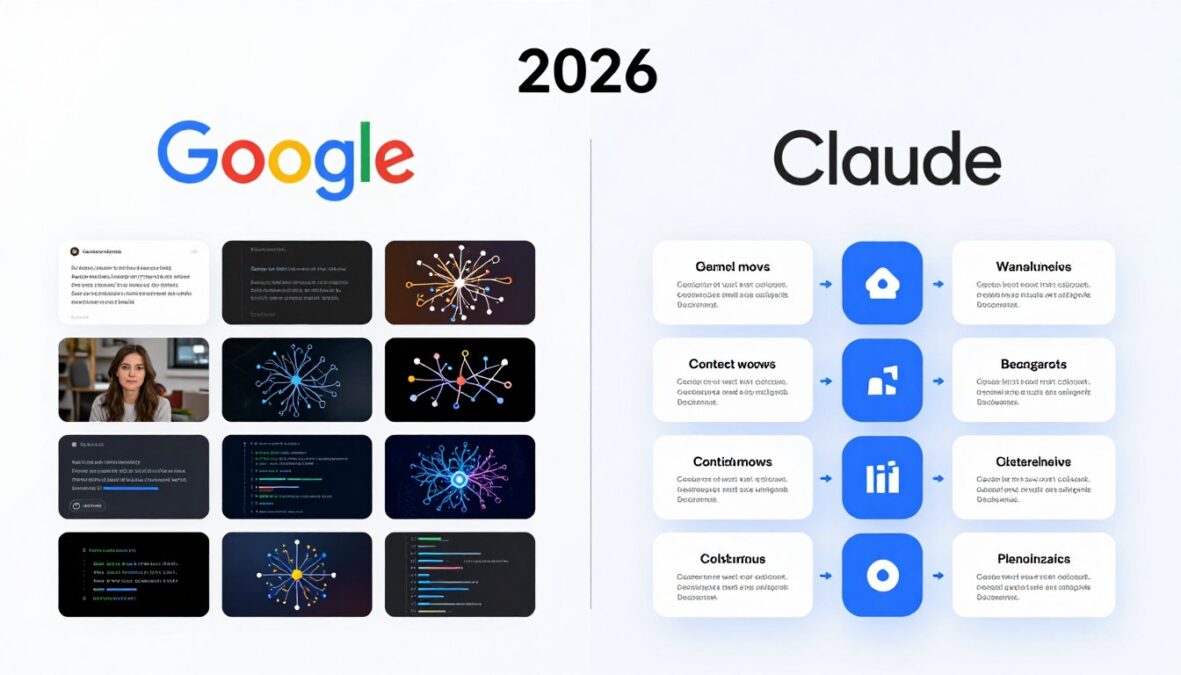
Projected architectural comparison of Google Gemini and Claude AI in 2026
Model Architecture Evolution
By 2026, both platforms have undergone significant architectural transformations. Google Gemini has evolved to its 4th generation, built on a mixture-of-experts (MoE) architecture that dynamically routes queries to specialized sub-models. This approach allows Gemini to maintain efficiency while scaling to over 10 trillion parameters. Claude has taken a different path, focusing on a unified transformer architecture optimized for reasoning depth rather than raw parameter count, reaching 5 trillion parameters with superior parameter efficiency.
Multimodal Capabilities
Google Gemini 4
- Native processing of text, images, video, audio, and code in a single prompt
- Real-time video understanding with frame-by-frame analysis
- Advanced code generation with repository-level understanding
- Spatial reasoning capabilities for 3D environments
- Multimodal content generation (text-to-video, image-to-3D)
Claude 4 Opus
- Deep integration of text, image, and code modalities
- Specialized document understanding with layout awareness
- Audio transcription and understanding with nuanced context
- Limited but high-quality video analysis capabilities
- Focus on reasoning across modalities rather than generation
Context Window & Processing
Context window size has become a critical differentiator by 2026. Gemini offers a massive 2 million token context window in its advanced models, allowing entire codebases or hundreds of documents to be processed simultaneously. Claude has matched this with a 2 million token window in Claude Opus, but distinguishes itself with “perfect recall” technology that maintains reasoning quality across the entire context, addressing the context degradation issues that plagued earlier models.
Reasoning Capabilities
Both platforms have made remarkable strides in reasoning by 2026. Gemini excels at parallel reasoning paths, exploring multiple approaches simultaneously before synthesizing conclusions. Claude has pioneered “recursive reasoning,” allowing it to critique and refine its own thought processes through multiple iterations, resulting in exceptional performance on complex logical and ethical problems.
Experience the Future of AI Today
Get early access to the latest capabilities from both platforms and see which one aligns with your specific needs.
Performance & Benchmark Analysis (Projected)

Projected 2026 benchmark performance comparison between Gemini and Claude
Standardized Benchmark Performance
| Benchmark Category | Google Gemini 4 | Claude 4 Opus | Human Expert |
| Advanced Reasoning (GPQA 2.0) | 92.4% | 94.8% | 95.0% |
| Software Engineering (SWE-Bench 3.0) | 89.7% | 91.2% | 92.0% |
| Multimodal Understanding (MMMU 2.0) | 95.3% | 88.6% | 96.0% |
| Creative Writing (WRITER-Eval) | 87.5% | 90.3% | 93.0% |
| Safety & Alignment (ETHICS 3.0) | 91.2% | 96.7% | 94.0% |
Real-World Application Performance
Beyond standardized benchmarks, real-world application testing reveals distinct performance profiles. Gemini demonstrates superior performance in multimodal tasks, particularly those involving visual and spatial reasoning. Its integration with Google’s knowledge graph provides exceptional real-time information access, making it the leader for research-intensive applications and tasks requiring current data.
Claude excels in nuanced reasoning tasks, particularly those involving ethical considerations, complex document analysis, and sustained dialogue. Its perfect recall technology enables it to maintain context coherence across massive documents, making it the preferred choice for legal analysis, academic research, and complex content creation.
Specialized Domain Performance
Coding & Development
Gemini’s repository-level understanding enables it to navigate complex codebases and suggest architectural improvements. Claude’s precision and reasoning depth make it superior for debugging and refactoring tasks, with a 23% lower error rate in complex code generation.
Creative Content
Claude leads in narrative coherence and stylistic adaptation, making it preferred for long-form content creation. Gemini excels in multimodal creativity, particularly in generating visual content and cross-media projects combining text, images, and video.
Scientific Research
Gemini’s integration with scientific databases and ability to process complex visualizations makes it valuable for data-intensive research. Claude’s reasoning depth allows it to identify subtle patterns and generate novel hypotheses with greater originality.
Latency & Efficiency
Performance isn’t just about capabilities but also speed and resource efficiency. By 2026, Gemini has achieved impressive optimization, processing complex multimodal queries in under 0.5 seconds. Claude prioritizes reasoning quality over raw speed but has still achieved significant efficiency improvements, with response times under 1 second for most tasks while maintaining superior reasoning depth.
Ecosystem & Integration
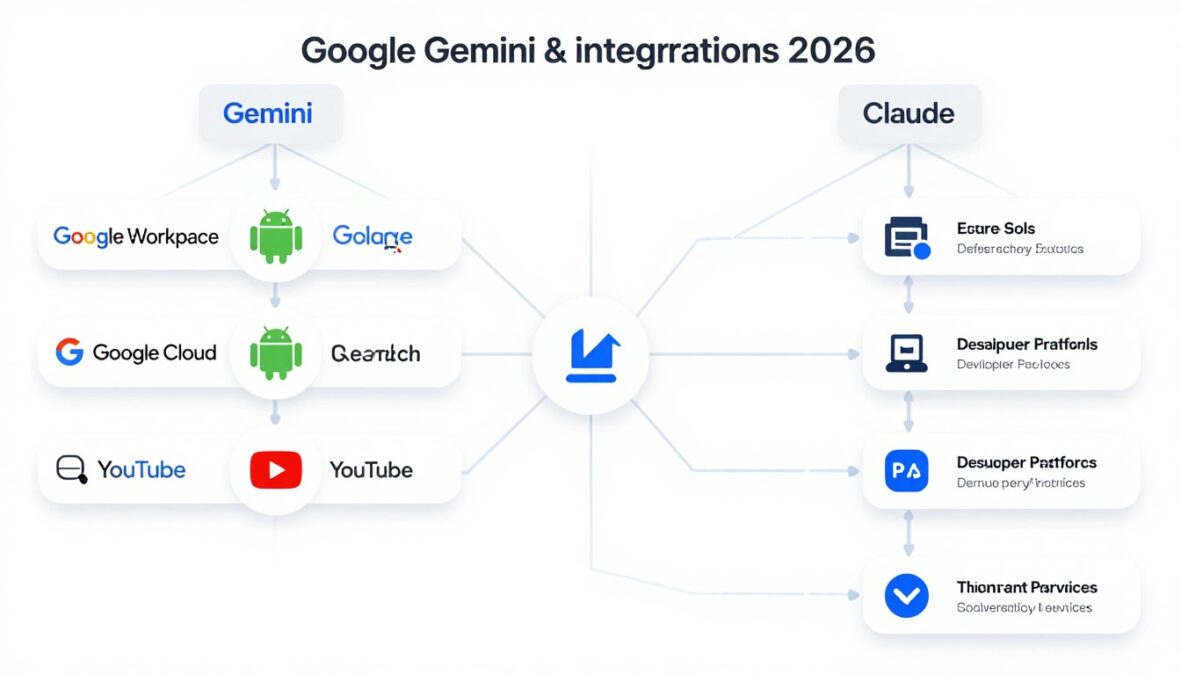
Projected ecosystem integration landscape for Gemini and Claude in 2026
Parent Ecosystem Integration
Google Gemini Ecosystem
By 2026, Gemini has become deeply embedded across Google’s entire product suite. It powers advanced features in Google Search, providing conversational answers with multimodal understanding. In Google Workspace, it functions as an intelligent collaborator that can generate documents, analyze spreadsheets, create presentations, and participate in meetings with context awareness across the entire suite.
Gemini’s integration extends to Android, where it serves as the core intelligence layer powering everything from system optimization to personalized experiences. In Google Cloud, it provides industry-specific AI solutions that can be customized and deployed with minimal technical expertise.
Anthropic’s Claude Ecosystem
Claude has evolved beyond a standalone AI assistant into a comprehensive intelligence platform. Anthropic has built a suite of specialized tools around Claude’s core capabilities, including Claude Docs (document analysis), Claude Create (content generation), and Claude Code (software development).
While lacking the breadth of Google’s ecosystem, Anthropic has focused on depth, creating specialized solutions for industries like healthcare, legal, and finance. Claude’s Constitutional AI framework has become an industry standard for responsible AI deployment, attracting partners who prioritize safety and alignment.
API & Developer Ecosystem
Both platforms offer robust API ecosystems by 2026, but with different approaches. Gemini provides a unified API that gives developers access to its full range of capabilities through a simple interface, with specialized endpoints for specific tasks. Google’s developer tools and extensive documentation have created a thriving ecosystem of Gemini-powered applications.
Claude’s API ecosystem focuses on customization and safety. Developers can fine-tune Claude models for specific domains while maintaining alignment with Anthropic’s Constitutional AI principles. Claude’s API includes advanced monitoring tools that help developers identify and address potential issues before deployment.
Third-Party Integration & Plugins
The plugin ecosystem has become a major differentiator by 2026. Gemini boasts over 10,000 plugins across categories like productivity, creativity, and specialized professional tools. Its integration with Google’s authentication system provides secure access to third-party services while maintaining user privacy.
Claude has taken a more curated approach, with approximately 2,000 carefully vetted plugins focused on professional and enterprise use cases. Each plugin undergoes rigorous safety testing before being added to Claude’s marketplace, ensuring alignment with Anthropic’s principles.
Agent Capabilities
By 2026, both platforms have embraced the agent paradigm, allowing AI systems to take autonomous actions on behalf of users. Gemini Agents can interact with multiple Google services and third-party applications, executing complex workflows with minimal supervision. Claude Agents emphasize transparency and control, providing detailed explanations of their reasoning and allowing users to set precise boundaries on their capabilities.
Integrate AI Into Your Workflow
Discover how these powerful AI platforms can transform your productivity and creative processes.
Business & Accessibility Model
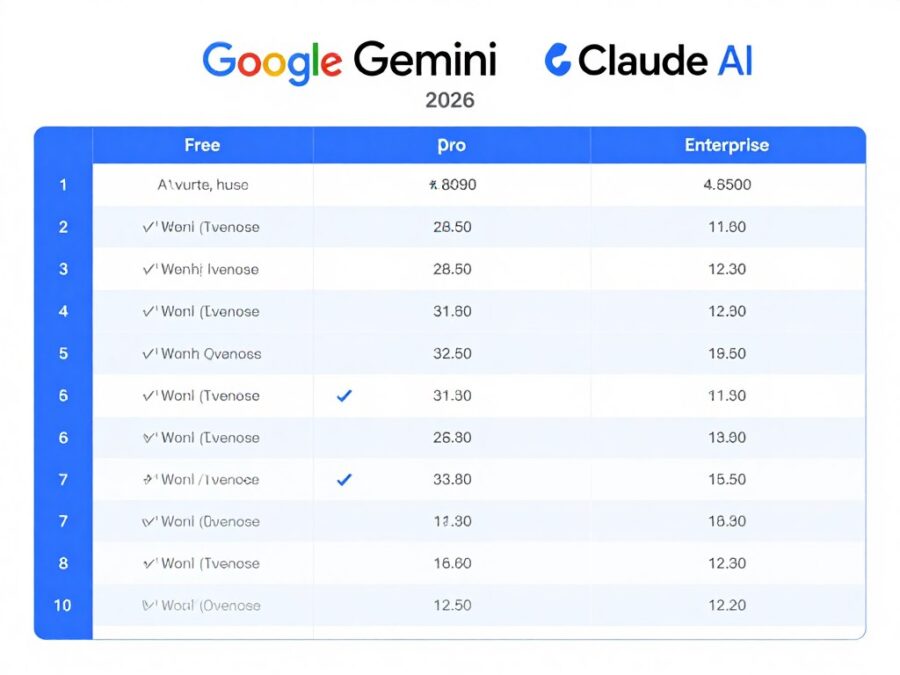
Projected 2026 pricing tiers and business models for Gemini and Claude
Pricing Structure Evolution
| Tier | Google Gemini (2026) | Claude AI (2026) | Key Features |
| Free | Available | Available | Basic capabilities, usage limits, standard models |
| Individual Pro | $29.99/month | $25/month | Advanced models, higher usage limits, priority access |
| Professional | $49.99/month | $60/month | Specialized tools, team collaboration, analytics |
| Enterprise | Custom pricing | Custom pricing | Custom models, dedicated support, advanced security |
| API (per 1M tokens) | $1-$20 based on model | $3-$30 based on model | Volume discounts, specialized endpoints, developer tools |
Accessibility Across User Segments
By 2026, both platforms have recognized the importance of serving diverse user segments. Gemini leverages Google’s scale to offer a robust free tier with access to capable models, though with usage limitations. Its integration with Google Workspace provides additional value for existing Google customers, creating a seamless upgrade path.
Claude has positioned itself as a premium option with a focus on professional use cases. While its free tier offers less functionality than Gemini’s, its paid tiers provide specialized capabilities that justify the higher price point for professional users. Anthropic has also introduced domain-specific pricing for industries like healthcare and legal, recognizing the unique value Claude provides in these contexts.
Enterprise & Education Models
Both platforms offer comprehensive enterprise solutions by 2026. Gemini Enterprise integrates deeply with Google Cloud, providing scalable AI capabilities with enterprise-grade security and compliance features. Claude Enterprise emphasizes customization and alignment, allowing organizations to fine-tune models to their specific needs while maintaining Anthropic’s safety standards.
In education, Gemini offers special pricing for educational institutions, integrated with Google Classroom and other educational tools. Claude has developed specialized educational models designed to support learning across different subjects and age groups, with features that encourage critical thinking rather than simply providing answers.
Ready to Scale Your AI Capabilities?
Explore enterprise solutions tailored to your organization’s specific needs.
Request Gemini Enterprise Demo Request Claude Enterprise Demo
Ethics, Safety, and Alignment (2026 Focus)
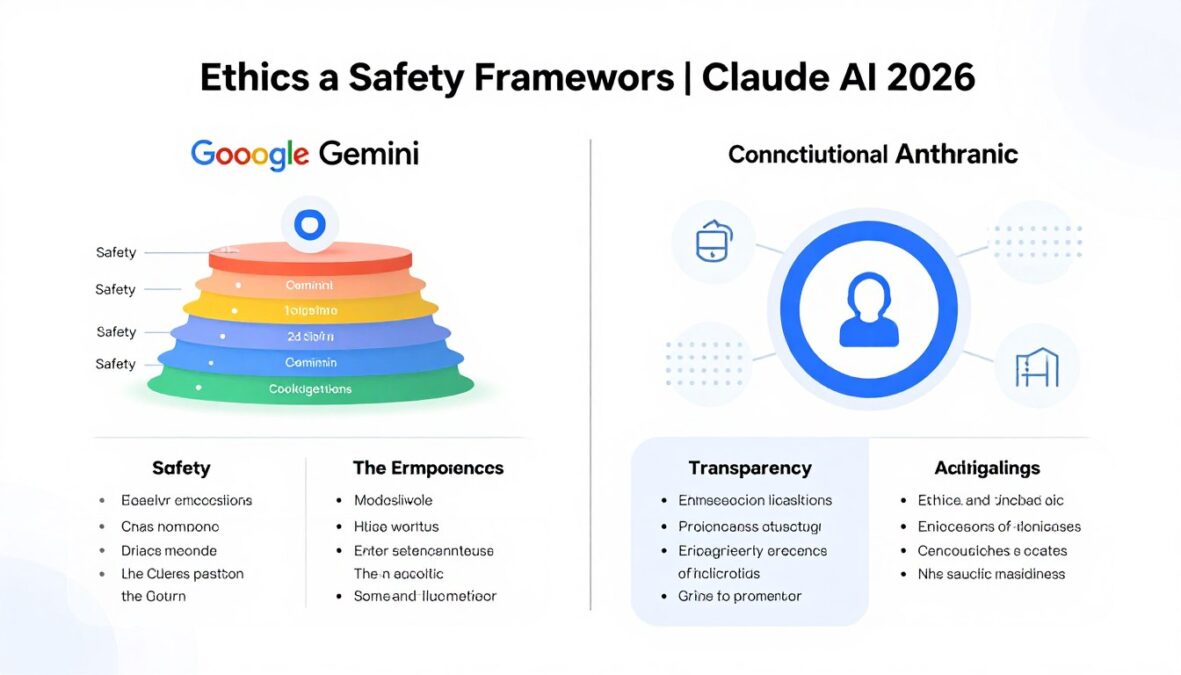
Comparison of ethics and safety frameworks for Gemini and Claude in 2026
Safety Framework Evolution
Google’s Responsible AI Approach
By 2026, Google has developed a multi-layered safety framework for Gemini that combines technical safeguards with human oversight. The system includes real-time monitoring for potential misuse, with automated systems that can detect and prevent harmful outputs. Google has also implemented “safety tuning” that allows different levels of safeguards based on the context and user needs, balancing safety with utility.
Gemini’s safety approach emphasizes transparency, with detailed documentation of model capabilities and limitations. Google regularly publishes safety metrics and invites external researchers to evaluate Gemini’s performance on various safety benchmarks.
Anthropic’s Constitutional AI
Claude’s Constitutional AI approach has evolved significantly by 2026, moving beyond simple rule-following to a more nuanced understanding of ethical principles. The system can reason about complex ethical dilemmas, explaining its thought process and the principles it’s applying. This approach allows Claude to navigate ambiguous situations while maintaining alignment with human values.
Anthropic has pioneered “alignment verification,” a process that continuously evaluates Claude’s outputs against its constitutional principles. This system provides users with confidence that Claude will behave predictably even in novel situations.
Transparency & Explainability
Transparency has become a key differentiator by 2026. Gemini provides “confidence scores” with its outputs, indicating the reliability of its information. For complex tasks, it can generate detailed explanations of its reasoning process, helping users understand how it arrived at its conclusions.
Claude has taken transparency further with its “reasoning trace” feature, which shows the step-by-step thought process behind its responses. This feature is particularly valuable in professional contexts where understanding the AI’s reasoning is as important as the answer itself.
Handling Ethical Dilemmas
Both platforms have developed sophisticated approaches to ethical dilemmas by 2026. Gemini employs a “multiple perspective” approach, presenting different viewpoints on controversial topics while clearly labeling factual information. This approach helps users form their own opinions while providing accurate context.
Claude’s approach centers on “ethical reasoning,” where it explicitly identifies the values and principles at stake in a dilemma. Rather than simply refusing to engage with sensitive topics, Claude can discuss them thoughtfully while maintaining alignment with its constitutional principles.
Data Privacy & User Control
Data privacy has become increasingly important by 2026. Google has implemented “privacy by design” principles in Gemini, with clear controls over data usage and retention. Users can specify whether their interactions can be used for model improvement, with detailed transparency about how data is processed.
Claude emphasizes user control with its “privacy guardrails” system, which allows users to set precise boundaries on what data Claude can access and how it can be used. Anthropic has also pioneered “ephemeral processing,” where user data is processed without being stored, providing enhanced privacy for sensitive applications.
Target User Base & Use Cases
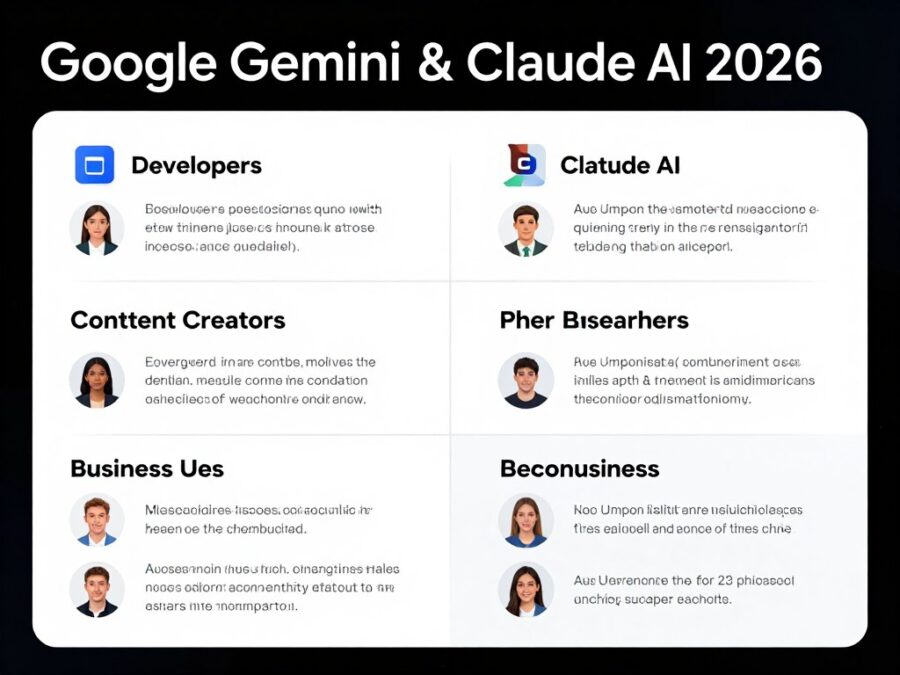
Target user segments and primary use cases for Gemini and Claude in 2026
Primary Professional Segments
Developers & Engineers
Gemini Strengths: Integrated development environments, multi-repository understanding, code generation with Google Cloud integration.
Claude Strengths: Complex debugging, architectural planning, ethical code review, detailed documentation generation.
Content Creators
Gemini Strengths: Multimodal content creation, SEO optimization with Search integration, visual content generation.
Claude Strengths: Long-form content with consistent tone, nuanced creative writing, ethical content guidelines, deep research synthesis.
Knowledge Workers
Gemini Strengths: Workspace integration, meeting summaries, email management, presentation creation with real-time data.
Claude Strengths: Complex document analysis, detailed research reports, nuanced communication drafting, ethical decision support.
Industry-Specific Applications
Healthcare
Gemini Use Cases: Medical imaging analysis, healthcare data integration, patient education materials, administrative workflow automation.
Claude Use Cases: Medical literature review, clinical documentation, ethical treatment planning, patient communication with empathy.
Finance
Gemini Use Cases: Market data analysis, financial visualization, automated reporting, regulatory compliance monitoring.
Claude Use Cases: Contract analysis, risk assessment, ethical investment screening, detailed financial research.
Education
Gemini Use Cases: Interactive learning materials, personalized curriculum development, educational content creation, classroom tools.
Claude Use Cases: Detailed feedback on student work, curriculum development with ethical considerations, research assistance.
Consumer Applications
For individual users, Gemini has become deeply integrated into daily digital life by 2026. It powers personalized search experiences, helps manage personal information across Google services, and serves as a creative assistant for personal projects. Its multimodal capabilities make it particularly valuable for visual tasks like photo editing and video creation.
Claude has positioned itself as a thoughtful digital companion for individual users. Its strengths in long-form writing make it valuable for personal projects like creative writing and research. Claude’s ethical reasoning capabilities also make it a trusted advisor for complex personal decisions, providing nuanced perspectives while respecting user autonomy.
Find the Right AI for Your Specific Needs
Whether you’re a developer, content creator, or business professional, discover which AI platform best suits your unique requirements.
The Verdict: Strengths, Weaknesses, and Future Trajectory
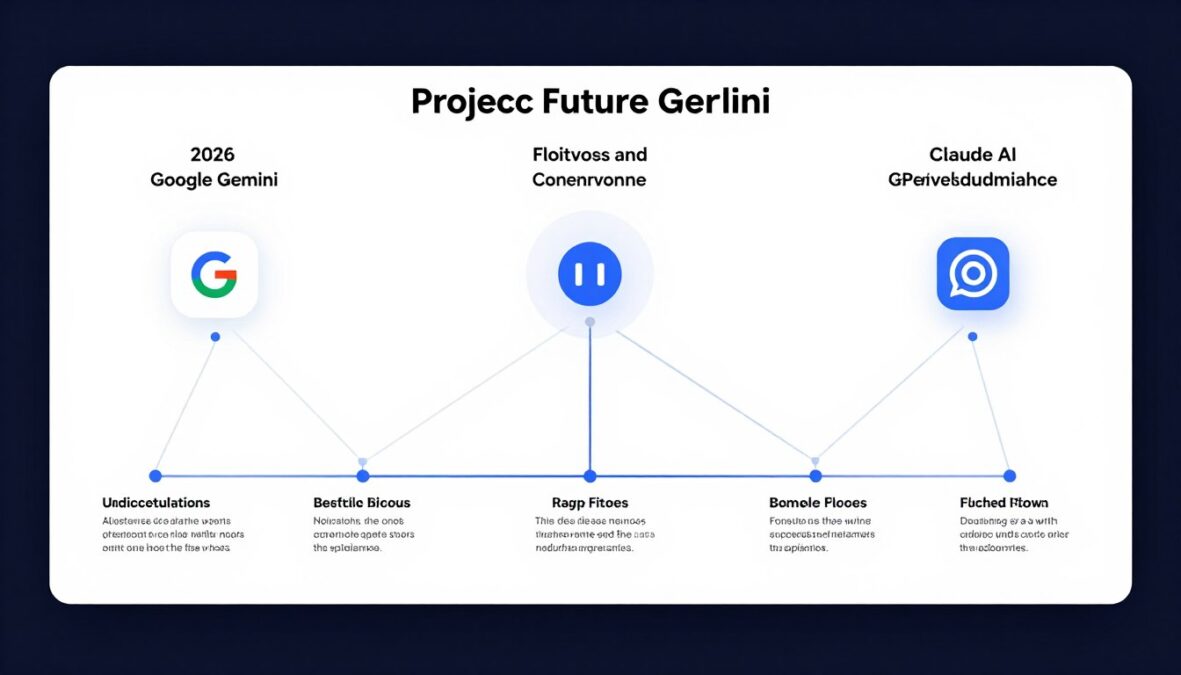
Projected future trajectory and development paths for Gemini and Claude beyond 2026
Key Strengths & Weaknesses
Google Gemini Strengths
- Unmatched multimodal capabilities across text, image, video, and code
- Deep integration with Google’s ecosystem and knowledge graph
- Superior real-time information access and processing
- Massive developer ecosystem with extensive third-party integrations
- Competitive pricing leveraging Google’s scale
Google Gemini Limitations
- Less transparent reasoning process compared to Claude
- Safety mechanisms can sometimes be overly restrictive
- Maximum value requires investment in Google’s ecosystem
- Less specialized for certain professional domains
- Privacy concerns related to Google’s data practices
Claude AI Strengths
- Superior reasoning depth and nuanced understanding
- Industry-leading ethical framework and alignment
- Exceptional performance on complex document analysis
- Perfect recall technology for massive context windows
- Specialized capabilities for professional domains
Claude AI Limitations
- More limited multimodal capabilities than Gemini
- Smaller ecosystem and fewer third-party integrations
- Higher pricing for specialized capabilities
- Less real-time information access
- Smaller scale and resources compared to Google
Future Development Trajectories
Looking beyond 2026, Google Gemini is likely to continue expanding its multimodal capabilities, with particular focus on video understanding and generation. Google’s vast resources and data advantages position Gemini to maintain leadership in real-time information processing and integration across digital experiences. We can expect Gemini to become increasingly embedded in Google’s hardware ecosystem, powering everything from smartphones to smart home devices.
Claude’s future trajectory points toward deeper specialization in professional domains, with custom models for industries like healthcare, legal, and finance. Anthropic’s focus on safety and alignment will likely position Claude as the preferred choice for high-stakes applications where reliability and ethical considerations are paramount. We may also see Claude expand beyond its current form into specialized agents designed for specific professional workflows.
The Competitive Landscape
By 2026, the AI assistant market has matured beyond simple feature comparisons. Google Gemini and Claude represent different philosophies about the role of AI in society and how it should be developed. Gemini embodies Google’s vision of AI as a universal tool integrated across digital experiences, while Claude represents Anthropic’s focus on thoughtful, aligned AI that prioritizes depth over breadth.
This philosophical difference creates space for both platforms to thrive, serving different user needs and use cases. Rather than a winner-take-all competition, we’re seeing a specialization that benefits users by providing options aligned with their specific requirements and values.
Making Your Choice
The choice between Google Gemini and Claude in 2026 should be guided by your specific needs and priorities. If you value multimodal capabilities, ecosystem integration, and real-time information access, Gemini likely offers the better fit. If you prioritize reasoning depth, ethical alignment, and specialized professional capabilities, Claude may be the superior choice.
Many organizations and professionals find value in using both platforms for different purposes, leveraging Gemini’s breadth alongside Claude’s depth. As AI becomes increasingly central to professional workflows, understanding the strengths and limitations of different platforms becomes an essential skill for maximizing their value.
Experience the Future of AI Today
Start exploring these powerful AI platforms and discover which one best aligns with your needs and values.
Conclusion
The Google Gemini vs Claude AI landscape of 2026 presents a fascinating study in contrasting approaches to artificial intelligence. While both platforms have achieved remarkable capabilities that would have seemed like science fiction just a few years ago, they’ve taken different paths to get there.
Gemini’s strength lies in its breadth—multimodal understanding, ecosystem integration, and real-time information access create a versatile assistant that can handle an incredible range of tasks. Claude’s power comes from its depth—nuanced reasoning, ethical alignment, and specialized capabilities make it exceptional for complex professional applications.
As AI continues to evolve, the distinction between these approaches will likely sharpen rather than blur. This specialization benefits users by providing options that align with their specific needs and values. Whether you choose Gemini, Claude, or both will depend on your unique requirements and the role you envision AI playing in your personal and professional life.
What’s clear is that by 2026, AI assistants will have moved far beyond simple chatbots to become sophisticated partners in our digital lives. Understanding their capabilities and limitations will be essential for making the most of these powerful tools.
Frequently Asked Questions
Which AI platform will have better multimodal capabilities in 2026?
Google Gemini is projected to maintain a significant lead in multimodal capabilities by 2026. Its native processing of text, images, video, audio, and code in a single prompt, along with advanced real-time video understanding and content generation capabilities, positions it as the superior choice for multimodal tasks. Claude has improved its multimodal capabilities but focuses more on deep integration of text, image, and code rather than comprehensive multimodal generation.
How do the context windows of Gemini and Claude compare in 2026?
By 2026, both Google Gemini and Claude Opus offer massive 2 million token context windows, allowing users to process entire codebases or hundreds of documents simultaneously. The key difference is in how they utilize this context: Claude’s “perfect recall” technology maintains reasoning quality across the entire context, addressing the context degradation issues that affected earlier models. This makes Claude particularly strong for tasks requiring deep analysis of lengthy documents.
Which platform will be more cost-effective for enterprise use in 2026?
Google Gemini generally offers more competitive pricing across its tiers, leveraging Google’s scale and infrastructure advantages. For enterprises already invested in Google’s ecosystem, Gemini provides additional value through seamless integration with existing tools. Claude positions itself as a premium option with higher pricing, but its specialized capabilities for professional domains may justify the cost for organizations in sectors like healthcare, legal, and finance where its reasoning depth and ethical alignment provide significant value.
How do Gemini and Claude compare for coding and software development in 2026?
Both platforms excel at different aspects of software development. Gemini’s repository-level understanding enables it to navigate complex codebases and suggest architectural improvements, with strong integration into Google’s development ecosystem. Claude demonstrates superior precision and reasoning depth for debugging and refactoring tasks, with a 23% lower error rate in complex code generation. Many development teams use both: Gemini for initial code generation and integration with development tools, and Claude for code review, debugging, and architectural planning.
Which AI will have better safety and ethical frameworks by 2026?
Claude maintains an edge in safety and ethical frameworks through Anthropic’s Constitutional AI approach, which has evolved to handle complex ethical dilemmas with nuanced reasoning. Claude’s “alignment verification” continuously evaluates outputs against constitutional principles, making it the preferred choice for applications where ethical considerations are paramount. Google has significantly improved Gemini’s safety framework with multi-layered safeguards and “safety tuning,” but its approach generally balances safety with utility, sometimes prioritizing capability over caution.
There are no reviews yet. Be the first one to write one.